Accessible communication
‘Together’ at the ‘Erfahrungsfeld’ – awakening the senses
A very special event took place in Nuremberg in mid-May: Irmgard Pirkl, PR manager at ‘Schwer-beschäftigt’, and Claus Haupt, head of the ‘Erfahrungsfeld’, took the participants on a journey into a completely different world. What was particularly fascinating was how many people you can reach simply by ‘thinking outside the box’. Just how important ‘plain and simple language’ is becoming in our digital media worlds. And what role explanatory videos and pictograms will play in the future.
After all, more and more people are getting older, which is often accompanied by some degree of sensory decline. And more and more people require tailored and varied forms of communication. Yes, our world is becoming increasingly diverse – and we communicators should adapt to this.
From the perspective of inclusion and demographic change, the topic of ‘accessible communication’ is therefore coming increasingly into focus, Irmgard Pirkl explained to us. Customers and members of the public want to be taken seriously – whether they are people with disabilities, sensory impairments, a migrant background, children or older people. Each target group has specific requirements in terms of communication, how it is presented, and the communication media themselves. It is therefore no longer acceptable for modern websites to fail to take these target groups into account. This is a call to action – not only, but above all, to us as communicators – which has immediately set us some homework. And the participants at the afternoon event took away another important lesson: less is more – and in accessible communication, this is arguably truer than anywhere else. For it is precisely here that the simplicity of language plays one of the most important roles. And that means: no foreign words, no Anglicisms, but all the more repetition. It is precisely the latter that PR professionals try to avoid in their texts.
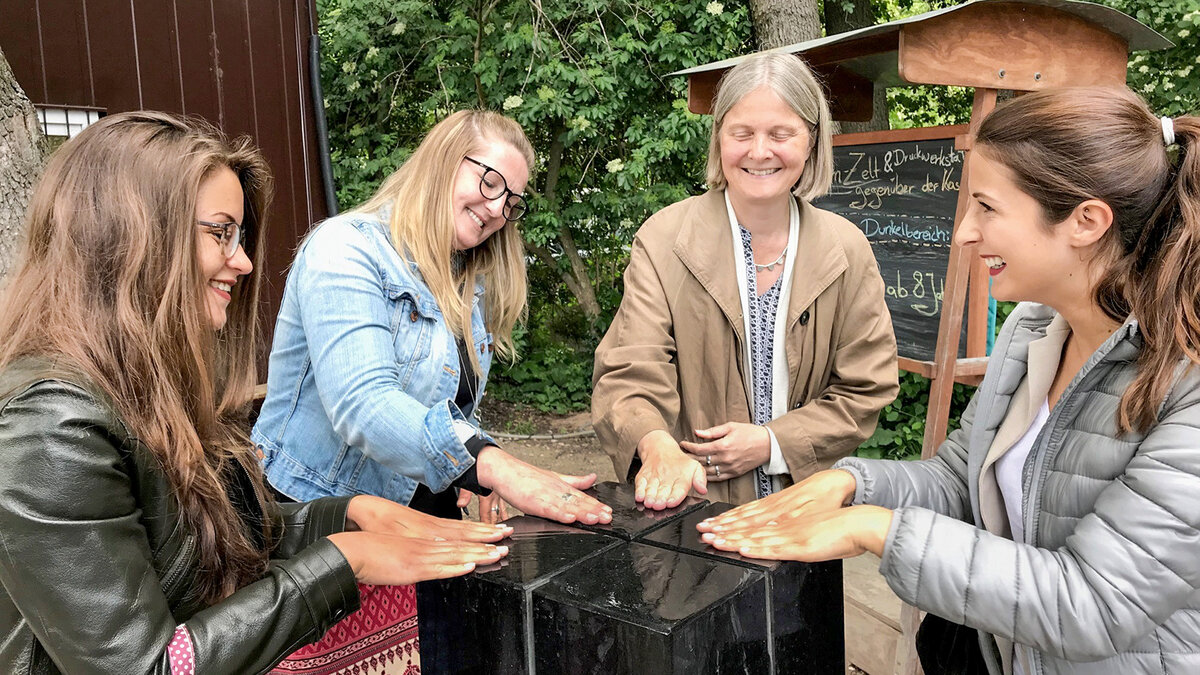
After this lesson, we headed out with Claus Haupt to the ‘experience field’ to sharpen our senses and immerse ourselves in the experience. This year’s theme fits the event’s motto perfectly: ‘Together’. And together, we North Bavarian communicators were able to ‘smell’ scents, ‘feel’ giant waterbeds, ‘sense’ the unfamiliar, or let ‘sound stones’ ‘resonate’. Our dexterity was put to the test, as was our sense of balance, in the ‘90-degree living room’. It was simply an unforgettable, cheerful and sociable afternoon, which drew to a close in the neighbouring beer garden.
Thank you once again for these very special experiences, dear Irmgard Pirkl from the bfz and dear Claus Haupt, Head of the Nuremberg Field of Sensory Experience and Head of the Department of Political and Cultural Education at the KUF, the City of Nuremberg’s Office for Culture and Leisure
Your team at DPRG Northern Bavaria, your colleagues from Kaltwasser Kommunikation
: Sarah Schöffler, Valentina Paolino and Brigitte Kaltwasser
Addendum: For anyone looking for benchmarks for good, accessible websites, we recommend a digital visit to the Federal Ministry of Labour and Social Affairs (BAMS). “Exemplary implementation,” says Irmgard Pirkl.