


Construction and infrastructure projects: Is online participation the future?
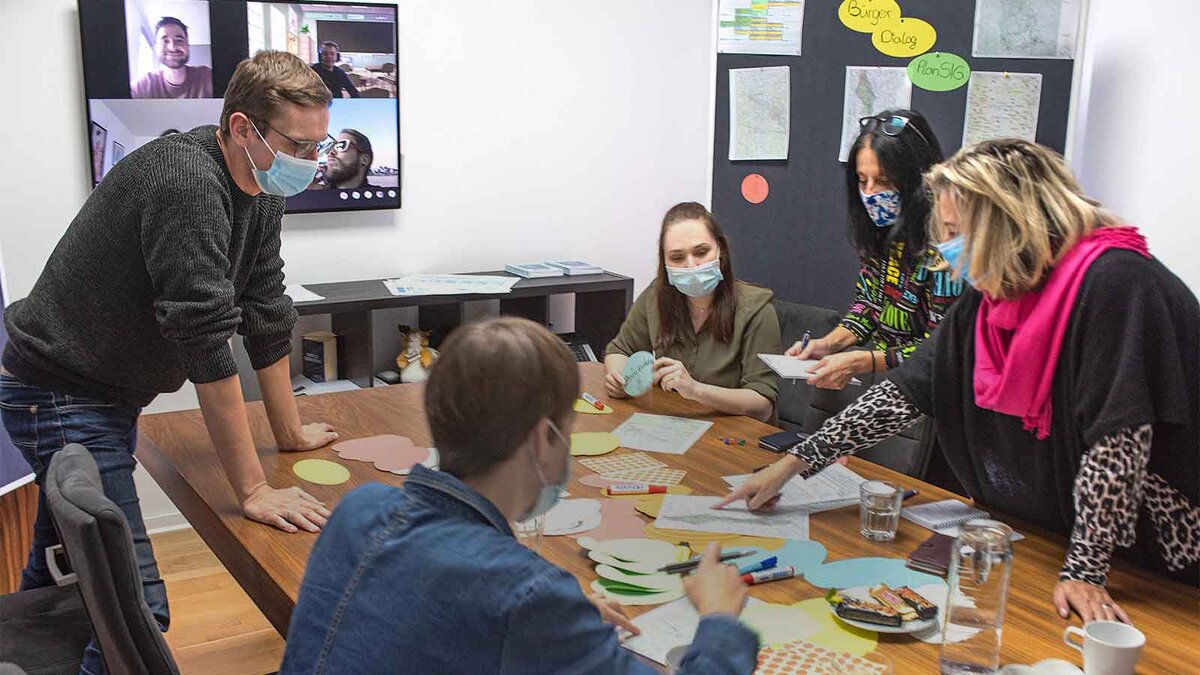
Legislative progress at last – the PlanSiG has come into force
Statutory participation and consultation formats, such as public consultation meetings held as part of planning approval procedures, can no longer take place as in-person events. To avoid delaying the approval processes for major construction projects, policymakers have reacted swiftly. At the end of May 2020, the Planning Safeguards Act (PlanSiG) came into force. The ‘Act to Ensure Proper Planning and Approval Procedures during the Covid-19 Pandemic’ is intended to ensure that approval procedures and public participation can continue despite infection control requirements. Authorities conducting the procedures can now organise the participation formats required by law as online consultations:
- Public display of planning documents may now be replaced by publication on the internet.
- Public notices required by local custom may be replaced by an online announcement. This means that the physical display of documents (often an entire shelf of folders full of expert reports) in town halls, district offices or other public authorities is no longer necessary.
- Anyone wishing to submit written objections or comments can now do so electronically, i.e. by sending an email.
- A public consultation meeting may be held as a telephone or video conference.
Email instead of letters – a major breakthrough?
The swift implementation of these legal changes is a positive sign. The fact that the shift towards greater online dialogue only came about under the pressure of a pandemic and currently has the status of a transitional arrangement is indicative of outdated administrative procedures. Of course, when it comes to public participation, accessibility must also take into account those who do not have access to the internet. Yet, for most citizens, writing letters and sifting through piles of paper at the town hall seem like relics from a bygone era. A shift towards the ‘online first’ principle has long been overdue in public administration and public participation. Our view: the new possibilities created by the PlanSiG must not remain a temporary solution but must be established in the long term.
Online formats everywhere – practise, practise, practise
Whether it’s consultation meetings or voluntary public engagement formats organised by project promoters: over the past few months, online formats have been tested more intensively than ever before and put through their paces on numerous occasions. However, a routine – such as that which exists for in-person events at most project organisers – has not yet been established. Various formats and online tools are being and have been tried out, and the market for these providers is currently evolving rapidly. Communications officers, construction project managers, politicians and members of the public are getting used to speaking to a wider audience in front of a webcam. Increasingly, people are asking whether there might be a more professional backdrop for video conferences than the ironing room at home. The experience that everyone involved is now gaining with web-based events will remain useful even beyond the pandemic. One thing is certain: online formats will remain the norm even after the pandemic.
Sometimes irreplaceable: a chat at the buffet
Precisely because so much is currently taking place online, the value of face-to-face encounters at in-person events is becoming all the more apparent. Not everything that an in-person event offers can be replaced by an online format. A matter-of-fact exchange of information works just as well in a video conference. But the interesting encounters and the moments that stick in the memory – let’s be honest – often happen over a coffee and a butter pretzel at the buffet.
It was only really when we in the Public Communication team had struggled to close our laptops in our home offices after countless video-conference public dialogues that we truly realised just how valuable and important emotions are in planning discussions and public forums. How can we foster trust between participants during online dialogue events? What can we, as facilitators, do to pick up on people’s emotions and the atmosphere in the virtual space? Questions like these are occupying us communicators much more intensely than before in these times.
‘New normal’? Please, in moderation!
After half a year of intensive learning and trial and error, everyone involved has made significant progress – both in terms of the framework conditions for online consultation (PlanSiG) and in terms of our personal experiences. We are gaining a clearer understanding of what works online and which discussions we would prefer to hold in person once we are allowed to do so again. The coronavirus pandemic has given us a boost as we embarked on this learning process. But even after six months, we are still a long way from reaching a ‘new normal’ when it comes to online dialogue. The digitisation of communication channels in planning permission procedures through the PlanSiG was long overdue. However, we hope that online formats do not become the norm in public participation. In a heated debate about building projects, it is both permissible and desirable to argue and debate face to face from time to time. We prefer to greet our fellow citizens with a genuine smile and are happy to say goodbye with a warm handshake.

The end of compulsory in-person attendance opens up new possibilities –
but also highlights shortcomings. It’s all about finding the right balance!
Dr. Karin Schrott
+49-911-530 63-119
ksc@kaltwasser.de