


D3 Congress: Germany – Digital – Democratic
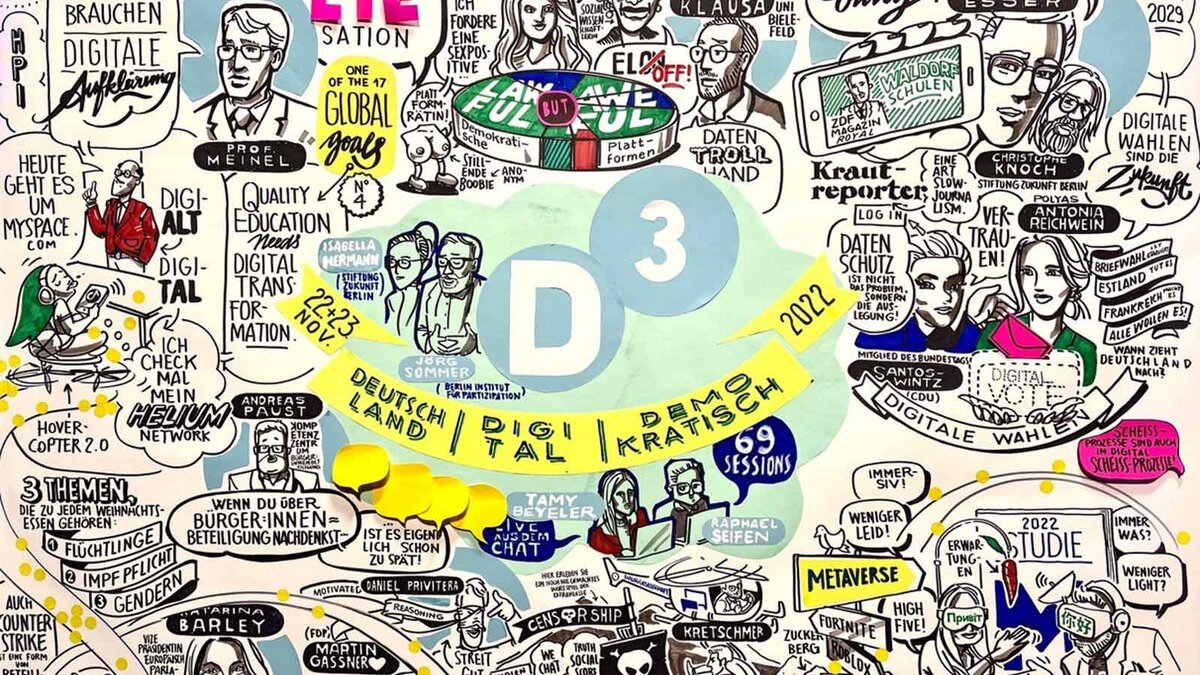
Ten theses as a common thread
To kick off the programme and, in a sense, to provide a common thread for the event, Jörg Sommer, a political scientist and director of the ‘Berlin Institute for Participation’, presented ten theses on digitalisation in democracy:
- Democracy is becoming more digital – across all areas
- Digitalisation is NOT democratisation
- Nothing is improved by digitalisation
- Digitalisation is a catalyst for shortcomings
- Digitalisation is a disorganiser
- Digitalisation makes democracy faster
- Digitalisation makes democracy more permanent
- Digitalisation makes democracy more subjective
- Digitalisation makes democracy more transparent
- Digitalisation makes democracy more diverse
Accordingly, digitalisation does not improve flawed processes; rather, it brings them into sharper focus. Nor does democracy become more democratic simply because it takes place digitally; it merely becomes faster and more transparent – for better or for worse.
Debates take place online in real time, ‘shitstorms’ must be managed, and opinion polls deliver immediate results that need to be processed and presented just as quickly.
Jörg Sommer, who has been working for more than 30 years as an expert and adviser to parliaments, ministries, foundations and associations, points out in this context that inertia has hitherto been a major strength of democracies: “Major shifts in direction have always been the result of protracted negotiation processes. Rapid shifts in direction create greater centrifugal forces at the periphery and deeper rifts at the centre. This is something we can clearly observe at present.”
Digitalisation across all areas of education, society and politics
The event covered a wide range of topics, from digital opportunities in schools and education, and the use of digital voting tools in citizens’ assemblies or political discourse, to the potential of virtual reality applications in urban development.
For example, digital participation platforms enable governments, public authorities and organisations to involve people in collective activities. Proposals for new projects, consultations on agreements, prioritising alternatives, planning public spaces, voting on the allocation of budgets, and many other possibilities could be mentioned here.
Best-practice examples of successful participatory processes made it clear that, for some city councils – such as those in Stuttgart or Mannheim – digital applications and platforms are already a key component of public consultations and participatory processes.
As a tool for visualising urban development projects, augmented reality opens up a wealth of possibilities. Citizens are ‘brought on board’ right from the start and can not only see what is being planned and what it is intended to look like, but they can also help shape the plans, make suggestions and vote. And the whole process is straightforward and quick, without having to visit the local authority’s offices.
Analogue is not dead
However, the value of analogue communication was also emphasised once again in the discussion, as not everyone is able to participate in digital services. People from migrant backgrounds who lack the necessary language or technical skills, people with disabilities, or older citizens who are not sufficiently tech-savvy must not be left behind in this digital transformation. It is essential either to create appropriate educational programmes or to ensure that analogue communication channels are not neglected for those who still require them.
Conclusion
For us as communicators, the conference has made it clear that we must keep track of the digital possibilities and assess, on behalf of our clients, when and to what extent it makes sense to incorporate digital tools. A combination of tried-and-tested, analogue events such as round-table discussions, supplemented by fast, versatile digital applications, can be a good solution. Particularly when illustrating complex planning processes in the infrastructure sector, the digital presentation of local conditions helps to foster a better understanding and, consequently, greater acceptance.
Image: ©Van Bo Le Menzel