Digital working environments
Digitalisation
The passionate discussion on the challenges of digital workplaces was the central theme of the sixth LWI (Leading Women in Industry) conference, held at the major German corporation Siemens on 22 June 2017. This in-house training programme, whose panel discussion on ‘Corporate Culture in the Age of Digitalisation’ also featured our company founder Brigitte Kaltwasser, is aimed at women in leadership roles. The so-called ‘Himbeerpalast’, Siemens’ headquarters in Erlangen, was once again fully booked this year with nearly 300 female participants.
The session on this highly topical subject was kicked off by physicist Dr Victoria Ossadnik, a member of the management board at Microsoft Germany, who presented Microsoft’s vision for the office of the future. In line with the demands of the digitalised world, there are no longer any fixed workstations at Microsoft’s new site in Munich-Schwabing. Instead, the site offers ideal conditions for a modern form of collaboration, as well as opportunities for the individual development of all employees.
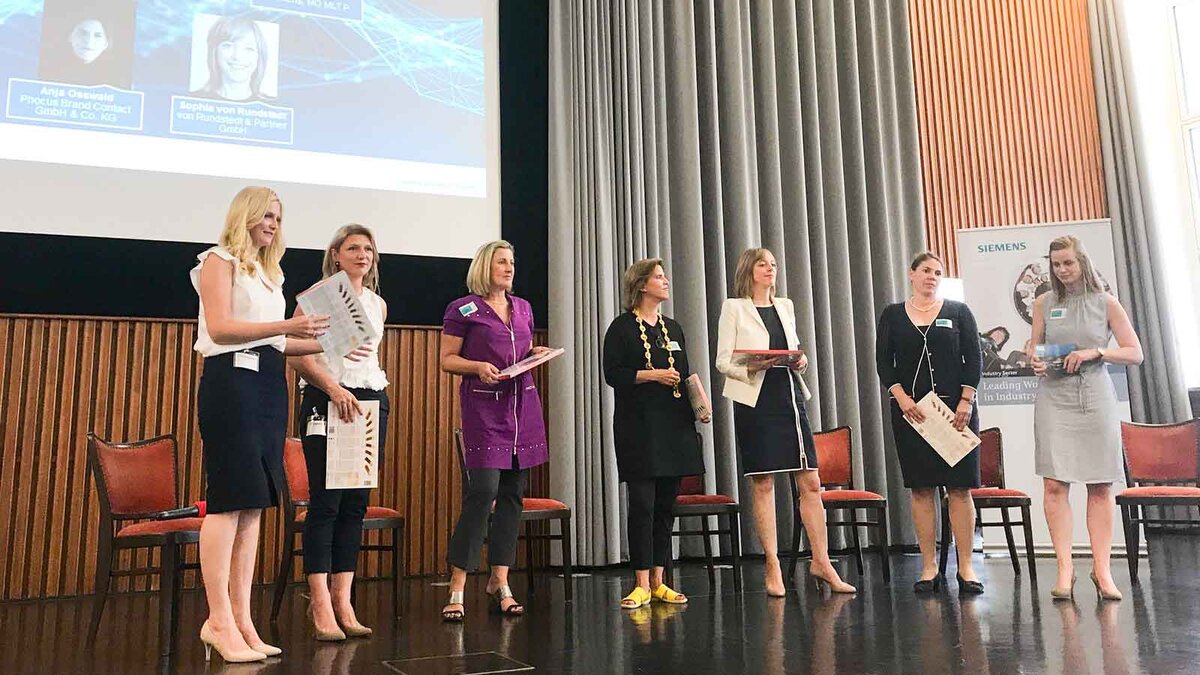
Panel discussion on the challenges of digitalisation in communication
However, modernisation also presents obstacles. Brigitte Kaltwasser, owner of the communications agency Kaltwasser, Olga Dick and Sabine Linz, managing directors of the online jeweller Amoonic, Julia Kehl, Vice-President of Supply Chain Management at Siemens; Anja Osswald, Managing Director at the engagement communications agency Phocus Brand Contact; and Sophia von Rundstedt, owner of the career consultancy Rundstedt & Partner. All the panellists agreed on one thing above all: that digital communication does not preclude face-to-face communication. Communication via digital tools merely complements ‘real’ communication, enabling a flexible and rapid response. Opinions, however, varied greatly on the extent to which emails might be replaced by alternatives.
The workplace of the future goes hand in hand with mobility, flexibility and trust
As the discussion progressed, it became clear that the female entrepreneurs had found that not all employees would welcome a ‘break-up’ of established corporate structures. The desire for mobile workplaces – that is, the freedom to choose one’s place of work – is not necessarily age-dependent, but rather depends on personality type. In more flexible working structures, a calm and tolerant approach, as well as a situational response to the individual needs of each person through a sensitive and coaching-oriented leadership style, are crucial. Furthermore, greater focus must be placed on employees’ results and performance – rather than on mere presence. Mobility, flexibility and trust – these are the key elements of a modern working world.
Kaltwasser Kommunikation set up mobile workspaces at its Nuremberg and Berlin offices two years ago. This means that staff manage their own time and can, for example, prepare texts or presentations whilst sitting in the garden with their laptop. Depending on the task at hand, staff can gather in the meeting room or meet in creative zones such as on the blue sofa, the terrace or at the kitchen counter. However, for the principle of free choice of workspace to work, rules such as the clean-desk policy must also be observed. This means that everyone clears their desk at the end of the working day. Piles of paper are now a thing of the past.
Read more:
Service: Press and Public Relations