


Standing up to the crisis
At the 13th Conference on Crisis Communication in Berlin, we discussed how best to prepare for crises and even turn them to our advantage
In a crisis, it’s your mindset that counts
Crises are neither avoidable nor predictable and therefore fundamentally impossible to plan for. In their keynote speeches, Martin Rieken (Head of Corporate Communications, TUI AG) and airline captain and crisis coach Mark Geßner, amongst others, highlighted how organisations can nevertheless prepare for crises. The unanimous view was that, whilst it is all very well to have manuals and checklists tucked away in a drawer, what really matters is the mindset of those taking action. This is because success or failure often depends on the psychological impact of how a company’s executive board or press spokesperson presents itself. And it is only one’s personal attitude that makes it possible to actively embrace the specific situation as a challenge and to act appropriately, confidently and calmly. Ideally, the crisis can even become an opportunity for improvement, renewal and economic growth.
The interface between disciplines
An award-winning case study on the organisation of Castor transports on the River Neckar demonstrated how transparent communication at the interface with public engagement and acceptance-building can create genuine added value for all parties involved. In the past, nuclear waste transports were synonymous with loud and often violent protests. The five Castor shipments in 2017 were a completely different story; for these, the Baden-Württemberg-based energy supplier EnBW used a waterway for the first time in Germany. Thanks to a prudent, proactive and long-term communication strategy, not only were protests largely avoided, but a high level of acceptance was also achieved amongst all stakeholders. The key elements: maximum transparency and engagement with the public. The result: lower costs for businesses and the general public, the avoidance of reputational damage, and the safest nuclear waste shipments in the history of the Federal Republic.
Crisis reporting and media management
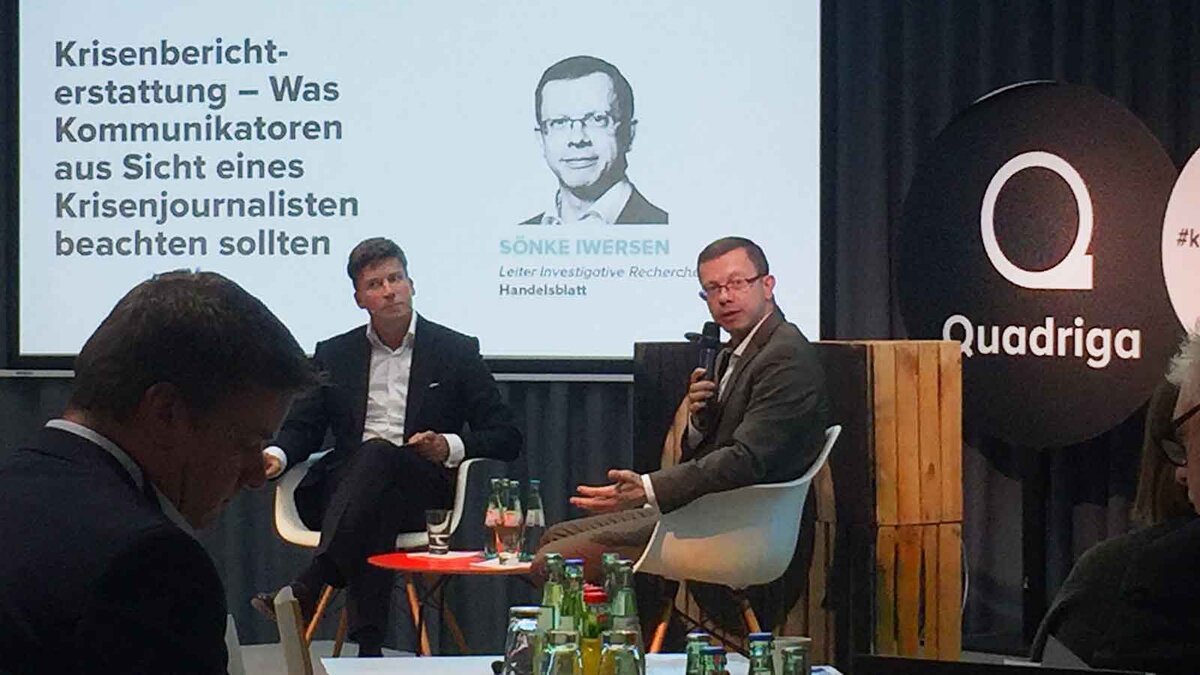
An integral part of crisis management is the coordination of media coverage and the designation of media contacts, who act as key multipliers for the public. In a live interview, the multi-award-winning crisis journalist Sönke Iwersen (Head of Investigative Journalism at the Handelsblatt) commented on what communicators should bear in mind during a crisis. He then took part in an open discussion in the plenary session on specific measures and behaviours to maintain the upper hand in public debates.
Follow-up with a positive culture of learning from mistakes – professional issue management
Once the immediate issue has been defused, everyone generally wants just one thing: to get back to business as usual as quickly as possible. Yet this is precisely the moment to embrace an open culture of learning from mistakes and to derive positive benefits from the situation that has been overcome: what can be learnt from the crisis and done better in future? How can crises be prevented in future? And where might there even be opportunities for the organisation, its processes, building its reputation or even further developing its business model? Documenting and reviewing the crisis provides a wealth of material for analysis, evaluation and optimisation – a treasure trove that simply needs to be tapped, rather than immediately returning to ‘business as usual’.
You can find further information on our communication consultancy services during a crisis in our Crisis Communication section.

Transparency and authenticity
are key during a crisis. We are constantly refining these communication skills within our network – so that you are well prepared.
Andreas Schauerte
+49-911-530 63-117
asc@kaltwasser.de
https://www.linkedin.com/in/andreas-schauerte-kk